
Professional Noise Monitoring & Noise Impact Assessments in Cape Town
Noise Cape Town provides professional, compliance-focused noise management solutions for events of all sizes. Our approach combines planning, targeted on-site monitoring, and real-time visibility through our online event dashboard — ensuring transparency, accountability, and meaningful compliance assessment.
All services are aligned with municipal requirements and professional best practice.
Noise Cape Town services include noise monitoring, noise impact assessments, noise management plans and acoustic consulting services throughout Cape Town and the Western Cape.
We work with event organisers, property developers, engineering consultants, environmental practitioners, venues, municipalities and businesses that require accurate noise assessments and practical compliance solutions.
Our services help clients meet regulatory requirements, manage community concerns, minimise environmental impacts and demonstrate compliance with local authority and environmental approval conditions.
NMP
Standalone Planning & Compliance Document
We prepare a professional Noise Management Plan tailored to your specific event, suitable for submission to municipalities, venues, or event stakeholders.
LIVE MONITORING
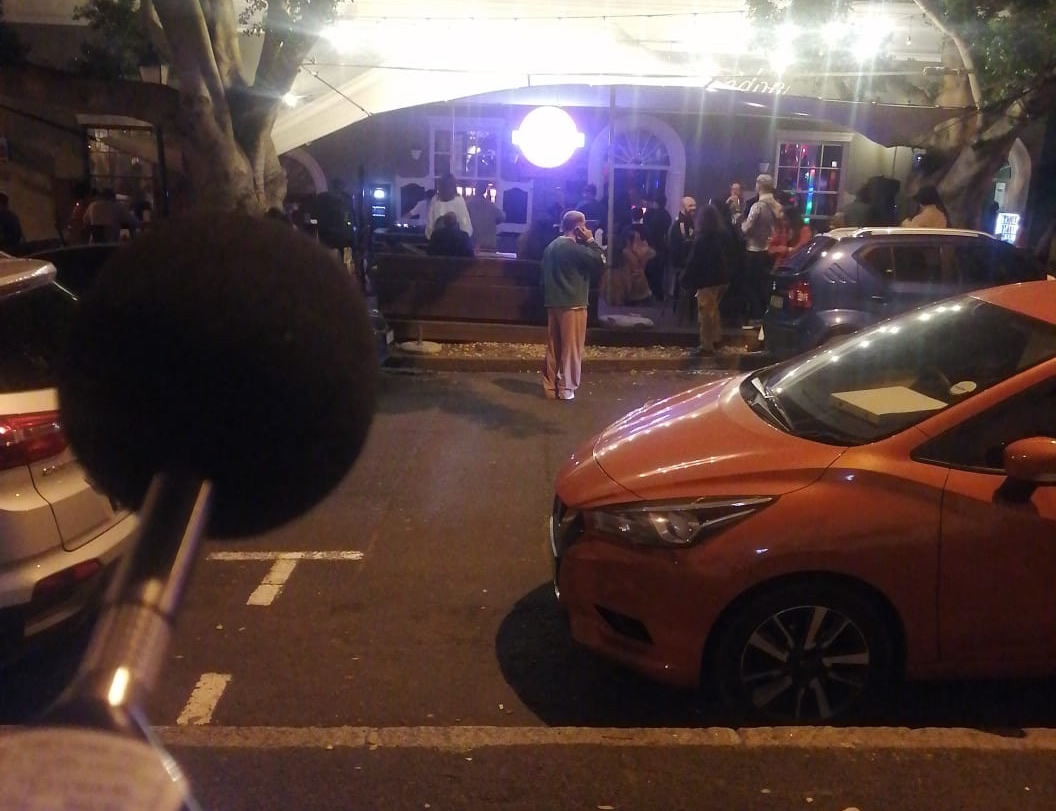
Professional Targeted Monitoring by an Environmental Acoustic Consultant
On-site noise monitoring is conducted using a Type 1 precision sound level meter, compliant with SANS / IEC 61672 standards.
NOISE ASSESSMENT REPORT
Formal Reporting & Compliance Review
On request, we can prepare a professional Post-Event Noise Impact Assessment based on recorded monitoring data.
This report includes:
-
Summary of monitoring results
-
Compliance assessment against applicable limits
-
Professional interpretation and conclusions
-
Supporting documentation suitable for municipal or legal review
For transparency, recorded monitoring data is made available via the online dashboard for informal review for up to 30 days after the event.
latest technology
Noise Alert System (Event Dashboard)
Real-Time Visibility & Accountability
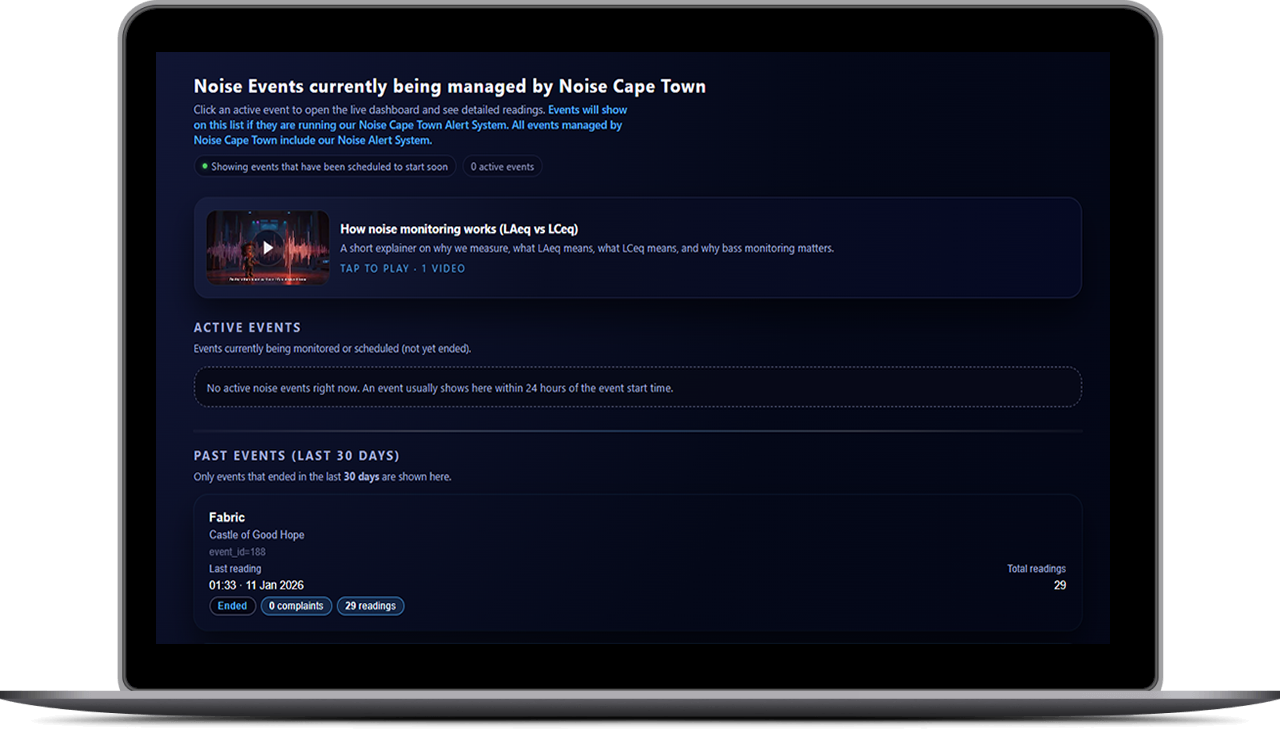
Each monitored event is supported by access to our online event dashboard, providing real-time noise visibility and alert functionality.
Features include:
-
Live noise level tracking during the event
-
Visual alert indicators to support proactive sound control
-
Centralised access for organisers, authorities, and stakeholders
-
Public transparency where required
When on-site monitoring is appointed, dashboard access is included at no additional cost for the duration of the event.
Dashboard access remains available for post-event review for a limited period.
STEPS YOU NEED TO KNOW
Simple guide to using us
Quote Request
Submit a quote request clearly indicating the event location, event dates, and operating times.
Please also note any sound checks or rehearsals, as these may require monitoring presence and must be planned for in advance.
Accept Quote
Once a quotation has been issued, your date and services are only secured upon written acceptance of the quote.
Following acceptance, the booking is confirmed and 50% deposit payment is required in order to receive your Noise Management Plan. The balance is due 7 days prior to the event start date unless otherwise agreed in writing.
Confirmation of event
Should any event details change — including dates, times, programme, or sound schedule — these must be communicated as soon as possible.
Early notification allows monitoring arrangements and compliance planning to be adjusted where applicable.
Noise Management Plan
Your Noise Management Plan (NMP) will be prepared once the quotation has been accepted and the required event information has been received.
The plan is tailored to your event and outlines applicable noise limits, monitoring strategy, mitigation measures, and operational controls in line with regulatory expectations.
Onsite Monitoring
During the event, professional noise monitoring is conducted using calibrated Type 1 instrumentation, supported by active engagement with DJs, sound engineers, and event management.
Monitoring is carried out in accordance with the approved Noise Management Plan, with intervention where necessary to support compliance and reduce complaint risk.
Noise Assessment Report
Where applicable, a post-event Noise Assessment Report is issued following the event.
This report summarises recorded noise data, key observations, and compliance outcomes, and provides a formal record for event organisers, venues, or authorities. This report is also charged for seperately and is not always required, this is dependant on whether the City requires it.
FAQ
1. What is noise monitoring for events?
Noise monitoring for events involves the professional measurement and management of sound levels generated during an event, using calibrated Type 1 precision sound level meters and structured compliance protocols.
The purpose is not only to record noise levels, but to actively manage sound in real time, ensuring that events operate responsibly within applicable limits or approved exemptions, while reducing the risk of complaints or enforcement action.
2. Why is noise monitoring important for events?
Noise monitoring provides:
-
A clear, objective record of sound levels
-
Early warning of potential non-compliance
-
Support for responsible sound management
-
Transparency for authorities, venues, and stakeholders
Without professional monitoring, event organisers are often exposed to uncertainty, complaints, or enforcement decisions made without contextual data. Monitoring introduces clarity, accountability, and defensible decision-making.
3. How does noise monitoring work?
Monitoring is conducted using Type 1 compliant instrumentation and is strategically targeted, not continuous by default.
Monitoring periods are allocated based on:
-
Peak sound windows
-
Sound system tuning and programme changes
-
Weather and atmospheric conditions
-
Complaint-risk periods
Live data is made available via the Noise Cape Town event dashboard, allowing proactive adjustments where necessary. Monitoring is guided by professional judgment rather than rigid time blocks.
4. What are acceptable noise levels for events?
Acceptable noise levels depend on:
-
Local authority regulations
-
Whether a noise exemption has been granted
-
Proximity to residential or sensitive receptors
-
Time of day and event duration
There is no single “one-size-fits-all” limit. Each event is assessed individually, and applicable limits are clearly defined in the Noise Management Plan or exemption conditions where applicable.
5. Do all events require a noise exemption?
No.
Some events operate fully within standard environmental noise limits and do not require an exemption. Others, by their nature, exceed normal limits and require formal authorisation from the local authority.
Part of our role is to advise whether an exemption is likely to be required and to assist with planning accordingly.
6. How are noise complaints handled during events?
Noise complaints are managed through a structured process:
-
Complaints are logged and assessed against live monitoring data
-
Sound teams are engaged where adjustments are required
-
Decisions are informed by real-time measurements, not assumptions
This approach ensures that responses are proportionate, documented, and defensible, while avoiding unnecessary disruption to the event.
7. Who is responsible for conducting noise monitoring at events?
Noise monitoring should be conducted by a competent Environmental Acoustic Consultant using calibrated equipment and established methodologies.
Noise Cape Town provides independent, professional monitoring and management services, acting as a technical interface between event organisers, sound engineers, venues, and authorities.
8. What is a noise exemption?
A noise exemption is a formal authorisation issued by the local authority that allows an event to temporarily exceed the normal environmental noise limits for a specific location, date, and time.
Environmental noise limits are designed for everyday activities. Events such as concerts, festivals, races, or public gatherings often exceed these limits by nature. A noise exemption acknowledges this and provides a controlled legal framework within which higher noise levels may be permitted.
An exemption does not mean unrestricted noise. It typically comes with conditions, such as:
-
Maximum allowable noise levels
-
Approved operating hours
-
Requirements for noise management and monitoring
-
Complaint handling procedures
9. What is the difference between running an event with a noise exemption vs without one?
Running an event with a noise exemption
When an exemption is in place:
-
Higher noise levels may be legally permitted for the approved period
-
Clear limits and conditions are defined in advance
-
Event organisers can demonstrate proactive compliance planning
-
On-site noise management and monitoring can be structured against agreed thresholds
-
Authorities and stakeholders have a transparent reference framework
This approach reduces uncertainty, improves communication, and significantly lowers enforcement and complaint risk.
Running an event without a noise exemption
Without an exemption:
-
Standard environmental noise limits apply at all times
-
Any exceedance may be considered non-compliant
-
Enforcement actions may be taken at the discretion of authorities
-
Events are more vulnerable to complaints, warnings, or shutdowns
-
There is often less clarity around acceptable operating margins
In these cases, stricter noise control and conservative sound management are essential.